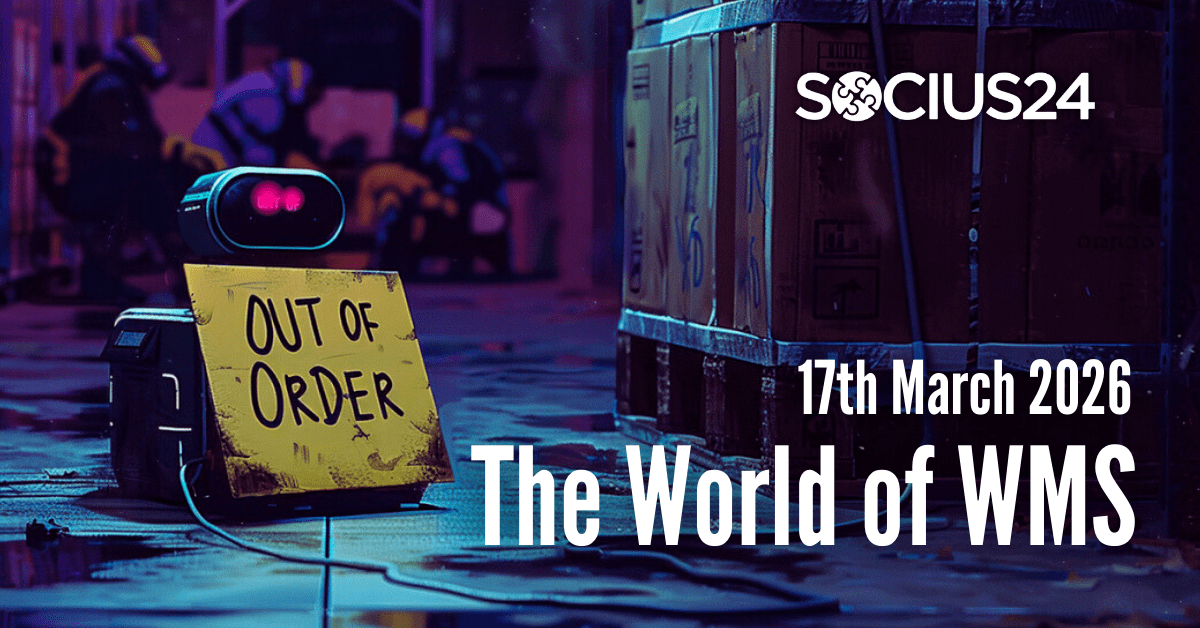
The Dark Warehouse Fantasy: what UK Warehouses actually need right now
The Dark Warehouse Fantasy
According to a new UK Vision Study, the future of warehousing is the dark warehouse — the current buzzword for fully automated facilities where humans are optional and the lights can stay off.
All sounds a bit sci-fi, really, doesn’t it?
But there’s just one small, if persistent, fly in the ointment.
And that’s that most UK warehouses can’t get their current systems to ask each other even the most basic of questions. Which means that, while the Vision Study is fantasising about a lights-out future, today’s reality looks somewhat different.
The gap between the dark warehouse vision and the reality on the floor
Across the industry, the numbers are showing us a consistent picture. Only 44% of warehouses have deployed any robotics at all. And of those that have, only 34% of the executives that decided to deploy them are entirely satisfied with the results.
The reasoning behind this movement to robotics is valid; there are simply not enough people available to fill demand in the UK logistics sector. Currently, there’s a 59,000-worker shortage of people who have the skills to work with modern technology. And to compound that, 20% of the engineers with enough experience to maintain it are due to retire this year.
So, the upshot of all of this is that the tech isn’t fully delivering yet, the people needed to run it properly are in short supply, and the employees who understand how to maintain and repair it are heading out the door, ASAP.
And yet, according to the CIPD, one in six UK employers — that’s around 17% of them — are planning to lay off workers in 2026, purely because of the gains they expect to make from automation and AI.
Not because it’s working brilliantly.
Not because they’ve deployed it and seen the results.
But rather, because they’re betting on its (as yet, unproven) potential.
The Harvard Business Review puts it rather nicely: companies are letting people go because of AI’s promise, not its performance.
Now, before we move on, it’s worth being clear about what “AI” means in the context they are using it here — they’re talking about physical automation: robots, AGVs, and so on. The capital-intensive infrastructure that companies are spending billions on to replace warehouse workers. Which is a very different thing from AI software tools that make your existing workers more effective by answering their questions or optimising their workflows. The two tend to get blended in conversations like this, but the distinction matters.
Even the most well-funded, most sophisticated automation projects in the world have found this dark warehouse transition harder than they expected. The capital requirements are significant. The operational complexity is even more significant. And that means timelines usually stretch and budgets sometimes burst.
And while none of this is a reason not to pursue automation, it is a reason to be honest about where we actually are, rather than pretending that we’re already where the Vision Study says we’ll be… eventually.
A gentle reality check for UK warehouses
Most warehouses aren’t ready for dark automation because they can’t handle light automation yet. Their WMS doesn’t talk to their ERP. Their ERP doesn’t talk to their warehouse floor systems. Their returns process touches six different systems, and none of them share data with any of the others. Rude.
So the real-life implication of this is that when pick accuracy drops, a lot of warehouse managers have no idea if it’s a training issue, a slotting issue, a workflow issue, or a system issue.
Which means – respectfully, and we say this with love – they’re not ready for robots.
The problem with dark warehouse thinking right now
Dark warehouses make for great Vision Study content. They look fantastic at trade shows. Consultants love talking about them.
But they’re not generating ROI. Not right now, and very probably, not for a long while yet.
Despite this, 17% of UK employers are apparently laying off workers to make room for the kind of automation that doesn’t exist yet. And at the same time, the automation that does exist is making nearly two thirds of the people using it quite unhappy.
What warehouse WMS optimisation actually looks like today
So, before you automate your people out, how about instead, you optimise the systems you already have?
Perhaps, before you spend £600,000 on AGVs, you could check whether your warehouse workers are spending 50% of their time walking back to terminals to check something simple, because your mobile infrastructure isn’t working properly. And before you start chasing dark warehouse fantasies, perhaps it would be better to make sure that your systems can answer basic questions… quickly.
The smartest warehouses right now aren’t dark. But they are deeply functional. And the difference comes down to warehouse WMS optimisation, making the infrastructure you already have work the way it was supposed to.
Blue Yonder’s Dispatcher WMS uses dynamic slotting that reacts to real velocity data in real time, rather than putaway decisions based on guesses someone made in 2019. Socius24’s User Services Portal (USP) eliminates the manual chaos of returns, moving stock from dock to QA to restock without your operators playing hours of telephone tag.
And AskUSP – Socius24’s latest product – gives you instant answers to operational questions you can ask in plain English. No SQL, no IT ticket, no waiting.
None of this requires laying people off. None of it costs £1 billion. It just needs your systems to actually work together – you know, like they’re supposed to.
The real future of warehousing
Dark warehouses are coming. Eventually. Maybe. Perhaps. For specific operations with specific requirements and really deep pockets.
For everyone else, the future looks rather more like this: warehouses where systems talk to each other, where workers aren’t burning through half their hours on manual workarounds, where you can answer basic operational questions without opening four spreadsheets, and where automation is helping your people do their jobs rather than replacing them.
It’s not flashy. It probably won’t ever make the Vision Study cut. But it will keep your business running while everyone else is chasing fantasies and laying people off in anticipation of technology that just isn’t available yet.
Top tip: go hire some of those people while you can.
Ready to stop chasing dark warehouse fantasies and start optimising what you already have? Book a demo and we’ll show you how Dispatcher WMS, USP and AskUSP can keep your lights on, your people employed, and your operations running.
Book a Demo Now
Latest News:
If you’ve enjoyed this article, subscribe for free to our weekly Newsletter
– The World of WMS –
for more of the same great information!